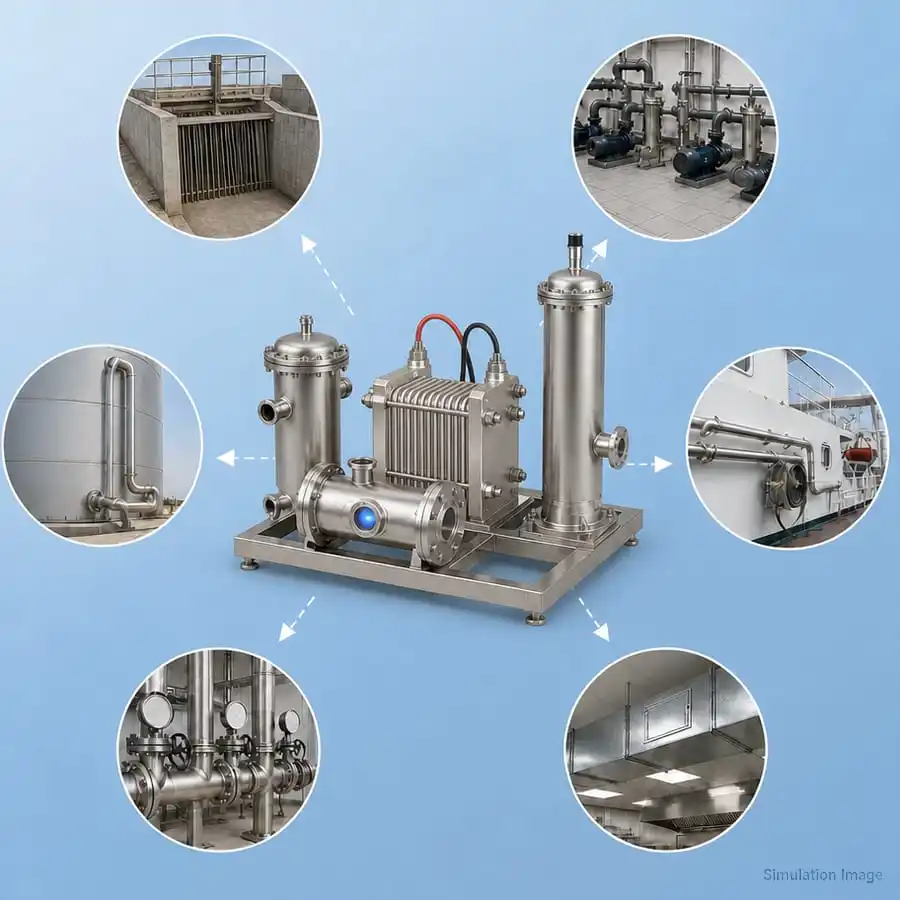
UVC LED seawater purification with electrolysis and ozone: what the light stage receives
What does a UVC LED stage actually do to seawater?
Light in the UVC band is absorbed by nucleic acid. A cell that absorbs enough of it can no longer reproduce, and that is the whole mechanism: a photochemical effect inside the water passing the emitter, not a filter, not a membrane, and not a change to the salt content.
That sets the target. A UV stage acts on microorganisms, and to a limited degree on some dissolved organics. It does not remove salt: dissolved chloride, sodium and hardness pass through unchanged, and a proposal that blurs the two is describing a different machine.
The light itself is where the engineering sits, because the budget is subtracted stage by stage before the water reaches the target. Suspended solids scatter it. Dissolved organic matter absorbs part of it. A few inorganic constituents - nitrate, and bromide at the shorter wavelengths - add a little more absorption. And the sleeve that separates the emitter from the water gathers a film that takes more away as it runs.
What decides the outcome is therefore not a figure printed on a lamp but how much light arrives at the target in the water actually being treated - a system quantity, established by measurement on that water. This is why a chamber that behaves well on a clean-water bench can under-deliver at a coastal intake with nothing wrong with the hardware: the same emitter is working through a different optical path.
A specification that can be checked names the water it was sized for: transmittance at the wavelength used, suspended solids, temperature, and the cleaning interval assumed for the sleeve. Those four lines are what make the number reproducible next season, when the water is not the same.
|
Suspended solids Effect: scatter the light before it arrives Known from: the site water analysis |
Dissolved organics Effect: absorb part of it in the water itself Known from: transmittance on that water |
Nitrate and bromide Effect: a small additional absorption Known from: a full water analysis |
Sleeve film Effect: grows with run time, unseen Known from: the stated cleaning interval |
Four deductions between the emitter and the target. All four are properties of the site and of run time, not of the chamber.
Why does the UV stage care what electrolysis puts in the water?
Because it changes the water the light has to cross, in two ways that belong in the UV calculation rather than in a chemistry appendix. Sodium chloride electrolysis is the first of the two upstream stages, and both of its effects arrive at the light stage.
The product first. At the anode, chloride is oxidized to chlorine, and because seawater carries bromide, that chlorine is converted almost at once into free bromine - hypobromous acid and hypobromite. What the water carries downstream is mainly a bromine oxidant rather than a chlorine one, with only a small chlorine fraction left.
Then the two consequences. That residual absorbs in the UVC band, so a light stage placed after the cell receives water with a lower transmittance than the water it was sized on; how much it costs depends on the residual concentration and on the optical path it sits in. And because the oxidant is a bromine species, the by-product chain that ends at bromate starts here rather than at the ozone stage.
Why does an ozone stage change the light budget too?
Ozone odor decomposition is the second of the upstream stages, and it changes the water the light has to cross in the same two ways the cell does: it leaves a residual, and it drives bromide along the chain the electrolysis stage has already started.
On the odor itself the chemistry is selective. Odor is a set of molecules - reduced sulfur compounds, amines, fatty acids - each with its own reactivity; ozone oxidizes many of them quickly, some slowly, and some intermediates carry odor of their own. That selectivity is why the claim cannot rest on the nose: olfactory fatigue, masking and dilution all produce "it smells better" without any compound having been removed.
What reaches the UV stage is the part that gets forgotten. Ozone oxidizes bromide directly, and bromate is the stable end point of that chain; a residual left in the water will also react with the halogen residual from the cell. Quenching one before the next costs something and has to be verified, and a residual that nobody measures is a residual that nobody manages.
Is disinfection the only thing the UV stage is judged on?
No, and the second criterion is the one that decides whether the first can be met. A UV stage is judged on a microbial measurement in the treated water, and on the light budget it was given: the transmittance of the water at the point of use, the residual arriving from upstream, and the condition of the sleeve at the time of the test.
What it is not judged on matters as much. It is not a desalination step, it is not an odor treatment, and it is not a bromide control. A proposal that lets one stage carry another stage's claim has stopped describing a system.
A design value is not evidence. A calculated figure says what the stage should deliver on the water it was modelled against; the proof is a measured comparison at the stated sampling point, on the water that actually arrives. The same logic explains why three routes acting on microorganisms do not simply add up: they can be complementary - different susceptibility, different location, one of them leaving a residual that protects a line - or redundant and paid for twice. "More must be better" is where that reasoning usually starts, and it is wrong.
How do you size the UV stage when three others surround it?
Three inputs, in this order: the sequence, the residual, and the optical path. Get the order wrong and the other two are calculated against water that will never exist.
Sequence. If the electrolysis cell sits upstream, the light stage works behind an absorber; if it sits downstream, the light stage sees the water it was probably sized on. That is not a layout preference - it decides whether the residual target and the light target can both be met at the same point. Either the UV stage goes first, or it is sized for the water it will actually see.
Residual. How much a residual costs in light depends on its concentration and on the optical path it sits in, so it belongs in the sizing calculation rather than in a rule of thumb. That has a corollary for the other stages: a residual target cannot be met by pushing oxidant higher and higher if doing so leaves the UV stage short of light.
Optical path. Transmittance has to be stated for the site rather than for clean water. Seawater is lower than fresh water at the same wavelength, it moves with season, rainfall and upstream filtration, and the sleeve adds a second loss that grows with run time. A cleaning interval is part of the size, not part of the maintenance schedule.
Then the record around them: a sequence diagram that shows which unit sits where, a residual management plan that says what is quenched and at which point, and a measurement plan that gives each claim its own sampling point. A combined skid is not one claim but a sequence of them, and the procurement question is not "what does the skid remove" but "show me the sequence, the residual plan and the measurements".
Frequently Asked Questions
Q1: Does a UVC stage desalinate seawater?
No. Light in the UVC band acts on microorganisms and, to a limited degree, on some dissolved organics. Dissolved salt, sodium and hardness pass through unchanged, so a light stage is not a desalination step and should not be presented as one.
Q2: Can electrolysis replace the UV stage?
Not as a rule, and it changes what the UV stage receives before it replaces anything. The cell leaves a residual oxidant that absorbs in the UVC band, so a light stage downstream of it works on water with a lower transmittance than the water it was sized on.
Q3: Does ozone affect the UV stage as well as the odor?
Yes. It leaves a residual and it drives bromide along the chain the electrolysis cell starts, and both reach the light stage. The odor claim itself still needs an identified-compound comparison, inlet against outlet - not an impression.
Q4: Why does the order of the stages matter?
Because a residual left by one stage changes the water the next one sees. That residual absorbs in the UVC band, so a light stage downstream of an electrolysis cell receives less than the same stage placed upstream, and a size calculated on clean water no longer applies.
Q5: What should the UV stage be specified against?
Three inputs, written down: a transmittance basis for the site's water, the residual the upstream stages will leave at that point, and the cleaning interval assumed for the sleeve. Without them the size cannot be checked next season, on water that has changed.
Q6: Can one test prove the whole skid?
No. The UV stage is proved by a microbial measurement on the treated water, the electrolysis cell by a residual measurement at a stated point, the odor stage by an identified-compound comparison. One result cannot stand in for the others.
Disclaimer and safety notice
This article is a technical description of process arrangement. It is not medical, public-health, environmental or legal advice, and it makes no claim about the performance of any specific system. UVC radiation is hazardous to eyes and skin; equipment using it is intended to operate only inside a fully enclosed housing or in unoccupied spaces. Ozone is an irritant gas and has to be handled with a gas-destruction path, and electrolysis produces hydrogen that has to be ventilated. Any installation has to complete the assessment, testing and certification applicable where it operates. Figures quoted in a project must come from measurement on that project's water, not from this article.